

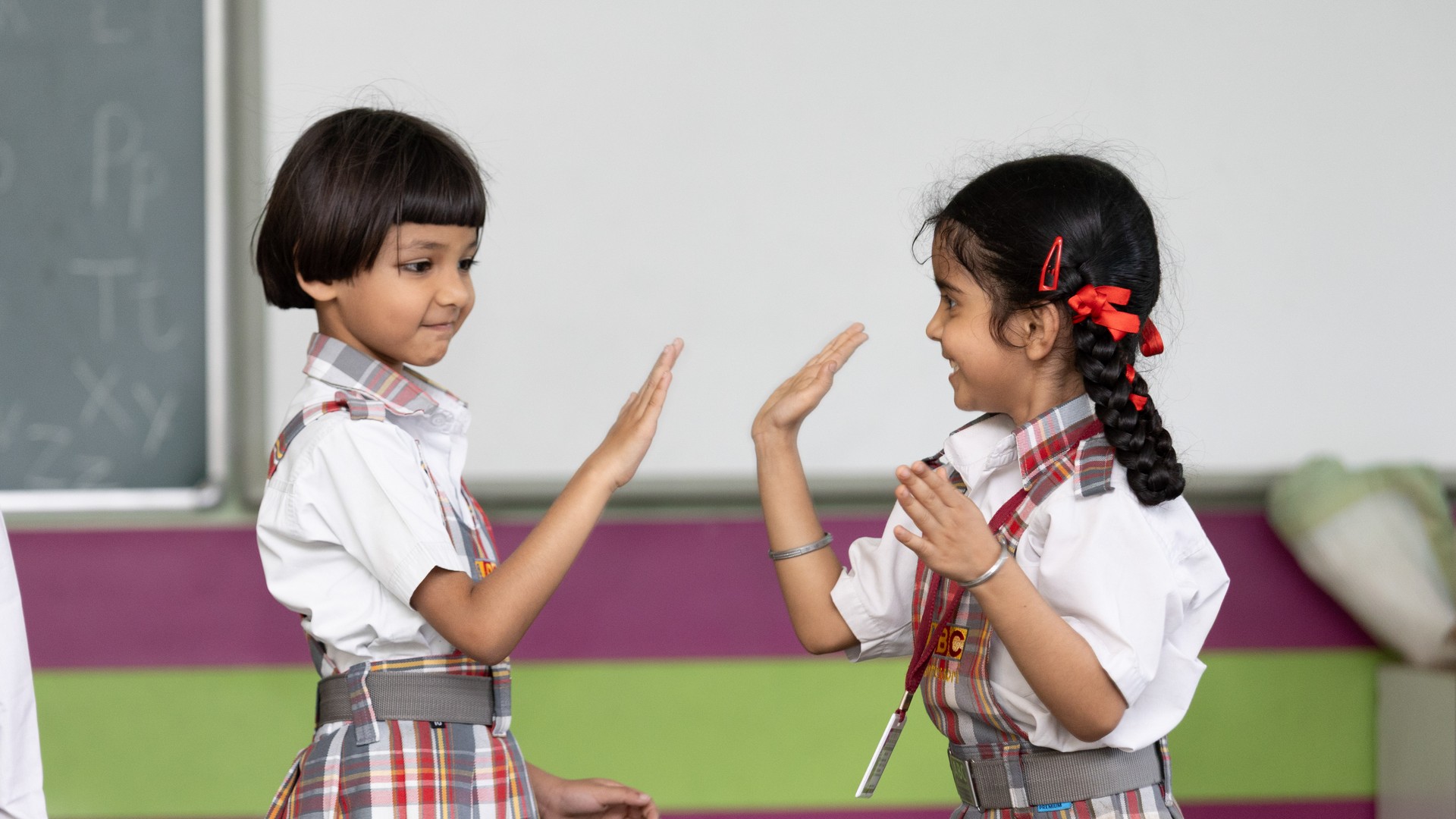
With the rapid paradigm shift in the education landscape, the traditional practice of rote learning and surface transmission is giving way to better and deeper pedagogical practices. Among these, concept-based learning is one such revolutionary process that prepares students for the demands of the 21st century.
The educators at BIPS have embraced this approach, conscious of its transformational impact on student development from the early years to high school.
Understanding Concept- Based Learning
Concept-based learning is a pedagogy that focuses on learning about underlying ideas, principles, and big ideas rather than memorizing disconnected facts in isolation.
This kind of pedagogy causes children to relate subjects to each other, think analytically, and transfer what they have learned to help them make sense of the world .
Instead of learning disconnected pieces of information, children acquire a deep understanding of how ideas relate to each other and can be transferred from one context to another.
The model worlds on the premise that if students understand big ideas, they are better positioned to comprehend new knowledge, solve tough problems, and apply their understanding to new situations.
This method sets the stage for a lifetime of learning, as students the intellectual tools needed to cope with an increasingly complicated world.
Building Foundations in Early Years
The conceptual years of school are the most formative years for building conceptual knowledge. In the conceptual years, young minds are naturally curious and desire to relate the concepts to each other.
BIPS understands that introducing concept-based learning at this age builds a solid platform for future academic success.
Conceptual learning in grease school classrooms is achieved in the form of unified units extending across several subjects for shared themes.
A good example would be a “Change” unit that integrates scientific knowledge of change, mathematical knowledge of patterns of growth, and literary analysis of character change.
Such a cross-disciplinary approach allows the students to understand that learning is not compartmentalized but connected.
Junior children at this age learn basic thinking skills such as observation, classification, and identifying patterns. The children understand how to ask relevant questions, make predictions, and make inference from evidence.
The basic skills act as a foundation for higher-order thinking in the following years.
Improving Understanding in Middle School
As the students move into their upper school years, concept-based learning is more advanced and complex. Students are now ready to learn abstract concepts and establish more complicated relationships between concepts.
BIPS is committed to assisting students further to extend their conceptual thinking to more advanced topics.
Middle school students are taught concepts that are not limited to subject domains. They can be taught the concept of “Systems” through studying ecosystems in science, political systems in social studies, and algebra systems in mathematics. This type of learning helps students view common patterns and principles that are not limited to subject domains.
In these years, students become more independent as learners, too. They learn to recognize significant ideas independently, make connections between new and prior knowledge, and apply conceptual understanding to solve problems. This sets the stage for the more challenging scholarly requirements of upper school.
Application Mastery of Senior School
At the senior school level, concept-based learning is appropriate as students can now analyze, synthesize, and evaluate at a higher level. At this level, BIPS students are expected to be showcasing deep conceptual understanding and applying it to actual, complex situations.
Senior students work with concepts that require higher-order thinking skills. They study past patterns to think about concepts like "Conflict" and “power:, use scientific principles to analyze problems of the environment, and use mathematical concepts to model complex phenomena.
Such interaction prepares students for studying at university and in the workplace.
The capstone experience usually consists of independent study projects where students must find suitable concepts, synthesize information drawn from various sources, and come up with original conclusions.
These projects are the culmination of years of concept-based learning and ready students for continued intellectual engagement.
Strengths During the Learning Process
The use of concept-based learning at BIPS has a number of benefits that extend far beyond classroom academic achievement. Students are able to think critically, so they can evaluate information, weigh up arguments, and make informed decisions.
They can be more creative problem solvers who can solve problems from a number of different angles.
Moreover, concept-based learning facilitates greater engagement with learning material. Students are more likely to feel internally motivated to dig deeper and connect personally with the material when they know about concepts.
This internal motivation comes back to better retention and more effective learning. The strategy also readies students for an unpredictable future by building skills that are transferable.

Instead of committing to memory particular facts that are sure to become outdated, students learn to tackle problems conceptually and apply what they have learned to new contexts.
Preparing Students for Future Success
In the future, concept-based learning is even more crucial. Our world is one of instantaneity and excess information, thus capability in conceptual thinking and connecting things become more crucial.
BIPS acknowledges that students who are competent in concept-based learning are best placed to thrive in an unpredictable world, unravel complex issues, and positively impact society.
The passage from primary to senior school through concept-based learning graduates students who are not just academically prepared but intellectually empowered.
They are well prepared with the skill of learning for the rest of their lives and are confident enough to face whatever the future may bring.